
Mezquita-Córdoba Facts
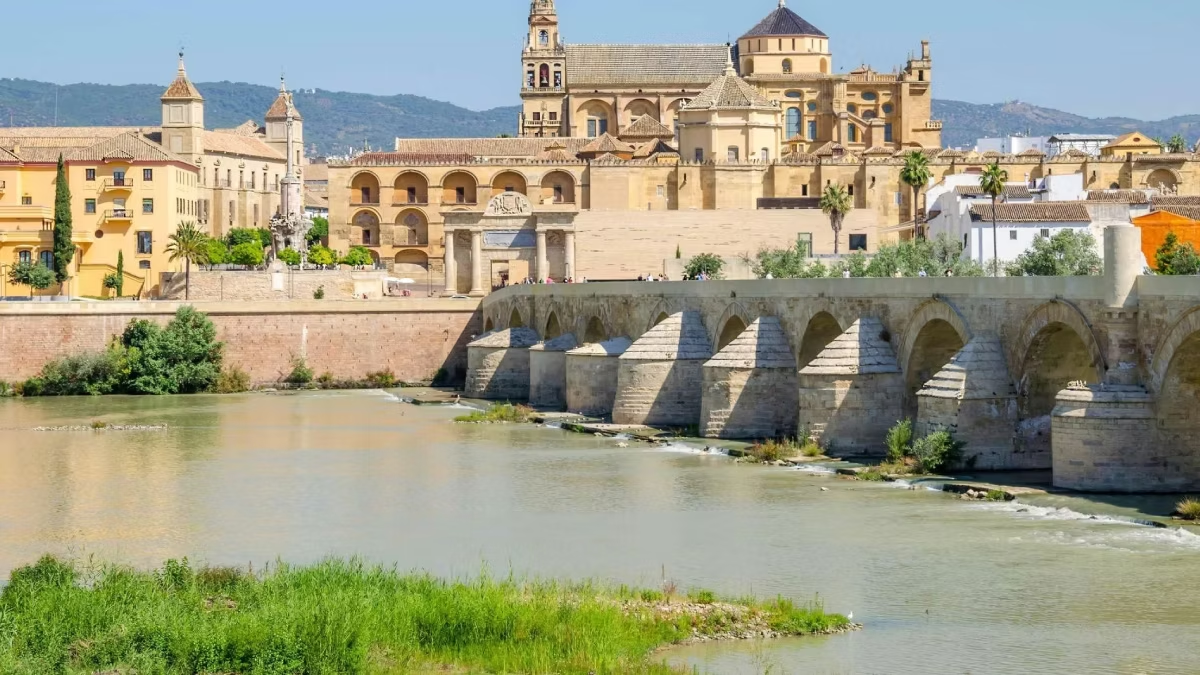
The Mezquita-Córdoba covers 24,000 square metres, contains over 850 columns, attracts over 2 million visitors per year, was declared a UNESCO World Heritage Site in 1984, and was built over a period spanning from 784 to 1523. The mihrab faces south rather than towards Mecca. At its peak, the mosque could accommodate 40,000 worshippers.
Some buildings demand to be understood through statistics as well as experience. The Mezquita-Córdoba is one of them — its numbers are as extraordinary as its architecture. This article gathers the key facts, dimensions, and details in one place, both for visitors preparing their trip and for those who want the essential information in a single reference.
Essential Facts at a Glance
| Fact | Detail |
|---|---|
| Official name | Mezquita-Catedral de Córdoba / Cathedral of Our Lady of the Assumption |
| Address | Calle Cardenal Herrero, 1, 14003 Córdoba |
| Total area | ~24,000 m² |
| Dimensions | ~180 m × 130 m |
| Number of columns | 856+ |
| Construction began | 784 AD |
| Final mosque expansion | 988 AD |
| Cathedral nave inserted | 1523 |
| Reconquista conversion | 1236 |
| UNESCO designation | 2 November 1984 |
| Annual visitors | 2 million+ |
| Standard admission | €13 |
| Free entry window | Mon–Sat 08:30–09:20 |
| Bell Tower height | 54 metres |
Construction and History
Construction began in 784 AD. Abd al-Rahman I ordered the construction of the first mosque on this site in 784, on the location of the Visigothic Basilica of San Vicente. The first phase was completed by 788.
The building was expanded four times over 204 years. The four main construction phases span from 784 (Abd al-Rahman I) to 988 (Almanzor) — a period of over two centuries during which the building roughly doubled in size with each major phase.
Córdoba was the largest city in Europe when the mosque reached its final form. At the height of the Caliphate of Córdoba in the 10th century, the city had an estimated population of 500,000 — larger than Constantinople and any Christian European city of the era.
The mosque was converted to a Catholic cathedral in 1236. When Ferdinand III of Castile took Córdoba during the Reconquista, the mosque was immediately consecrated for Christian use.
A Renaissance nave was inserted in 1523. Holy Roman Emperor Charles V approved the construction of a full cathedral nave inside the prayer hall, requiring the demolition of approximately 60 columns.
The building has been an active place of worship continuously since the 6th century. From its origins as the Visigothic basilica of San Vicente through to its current status as the active Catholic Cathedral of the Diocese of Córdoba, the site has been in uninterrupted religious use for approximately 1,500 years.
Dimensions and Scale
The total complex covers approximately 24,000 square metres. This makes it one of the largest religious buildings in the world by floor area.
The prayer hall alone covers approximately 15,000 square metres. Larger than many entire medieval cathedrals.
The building measures approximately 180 metres north-south and 130 metres east-west. The outer walls enclose a complete city block.
At its peak capacity, the mosque could accommodate approximately 40,000 worshippers. This made it one of the largest mosques in the world at the time of its construction.
Before being surpassed, it was the second-largest mosque in the world by surface area — after the Mosque of Mecca, and later surpassed by the Blue Mosque in Istanbul (built 1588).
The Columns
The prayer hall contains over 856 columns. The exact count varies depending on how partial and embedded columns are counted, but 856 is the most widely cited figure.
The columns were sourced from across the former Roman empire. They were recycled from Roman temples, public buildings, and the Visigothic basilica that preceded the mosque. They vary in material (marble, jasper, granite, porphyry), height, and capital design.
No two column capitals are identical. Because they were gathered from different locations and periods, each capital is unique — a visual record of the classical world assembled in a single building.
The columns support a double arch system that was entirely new in Islamic architecture. The alternating red brick and white stone horseshoe and semicircular arches above the columns became the defining visual feature of Andalusian Islamic architecture.
The Mihrab and Byzantine Mosaics
The mihrab faces south, not towards Mecca. Unlike most mosques, whose mihrab indicates the direction of Mecca (generally southeast from Spain), the Mezquita-Córdoba’s mihrab faces south — following the orientation of the Great Mosque of Damascus and reflecting the Umayyad dynasty’s Syrian origins.
The gold mosaics around the mihrab were made by Byzantine craftsmen from Constantinople. Caliph Al-Hakam II requested and received craftsmen from Byzantine Emperor Nikephoros II Phokas in the 961–976 phase of construction. The mosaics use gold tesserae and depict Quranic calligraphy and geometric patterns.
The mihrab is an octagonal chamber, not simply a niche. This architectural form was unprecedented in earlier Islamic religious buildings. The scallop-shell vault above the entrance is one of the most complex vaulted forms of the medieval Islamic world.
UNESCO and Recognition
Declared a UNESCO World Heritage Site on 2 November 1984. The Mezquita was among the first Spanish monuments to receive this designation, based on four criteria: being a masterpiece of human creative genius, representing a significant exchange of human values, providing a unique testimony to a cultural tradition, and being an outstanding example of a significant era.
In 1994, UNESCO extended the designation to the entire historic centre of Córdoba. The Mezquita remains the centrepiece of this wider World Heritage zone.
In June 2014, UNESCO awarded the Site of Outstanding Universal Value distinction. This further recognition acknowledged that the building’s active religious use has ensured its continuous preservation.
The building is managed by the Cabildo Catedral de Córdoba, the cathedral chapter, which has been responsible for the monument since 1236 — an unbroken institutional stewardship of nearly 800 years.
Visitor Information
Over 2 million people visit the Mezquita annually. It is consistently one of the three most visited monuments in Spain.
Standard adult admission is €13. The same price applies whether tickets are bought online or at the door.
Free entry is available Monday to Saturday, 08:30–09:20. No ticket is required during this window. It is one of the few major European monuments where free daily access is built into the schedule.
The night tour (Soul of Córdoba) admits a maximum of 80–100 people per session. This strict cap makes it one of the most intimate after-hours experiences at any major monument in Spain.
The Bell Tower is 54 metres tall — the highest point in the historic centre and visible from most of the surrounding old town.
The 2025 Fire
A fire broke out on 8 August 2025 at 21:10. It started in a chapel used as a warehouse in the Almanzor extension and spread to the adjacent Chapel of Expectation.
The roof of the Chapel of Expectation collapsed after firefighters intervened — the weight of water used to extinguish the fire exceeded the capacity of the damaged structure.
A comprehensive restoration project was announced in September 2025, projected to complete by mid-2026. UNESCO praised the cathedral chapter’s rapid response.
The main visitor areas are fully open. The prayer hall, the mihrab, the cathedral nave, and the Patio de los Naranjos are unaffected. A section of the Almanzor extension has scaffolding in place.
Frequently Asked Questions
How many columns are in the Mezquita?
Over 856, though the precise count varies. The figure of 856 is most widely cited.
How big is the Mezquita?
Approximately 24,000 square metres total, with dimensions of roughly 180 × 130 metres.
When was the Mezquita built?
Construction began in 784. The building was expanded in phases through 988. The Catholic cathedral nave was inserted in 1523.
How many visitors does the Mezquita receive each year?
Over 2 million annually, making it one of the three most visited monuments in Spain.
What is the height of the Bell Tower?
54 metres — the highest structure in the historic centre of Córdoba.
When was the Mezquita declared a UNESCO World Heritage Site?
2 November 1984.
