
History of the Mezquita-Córdoba
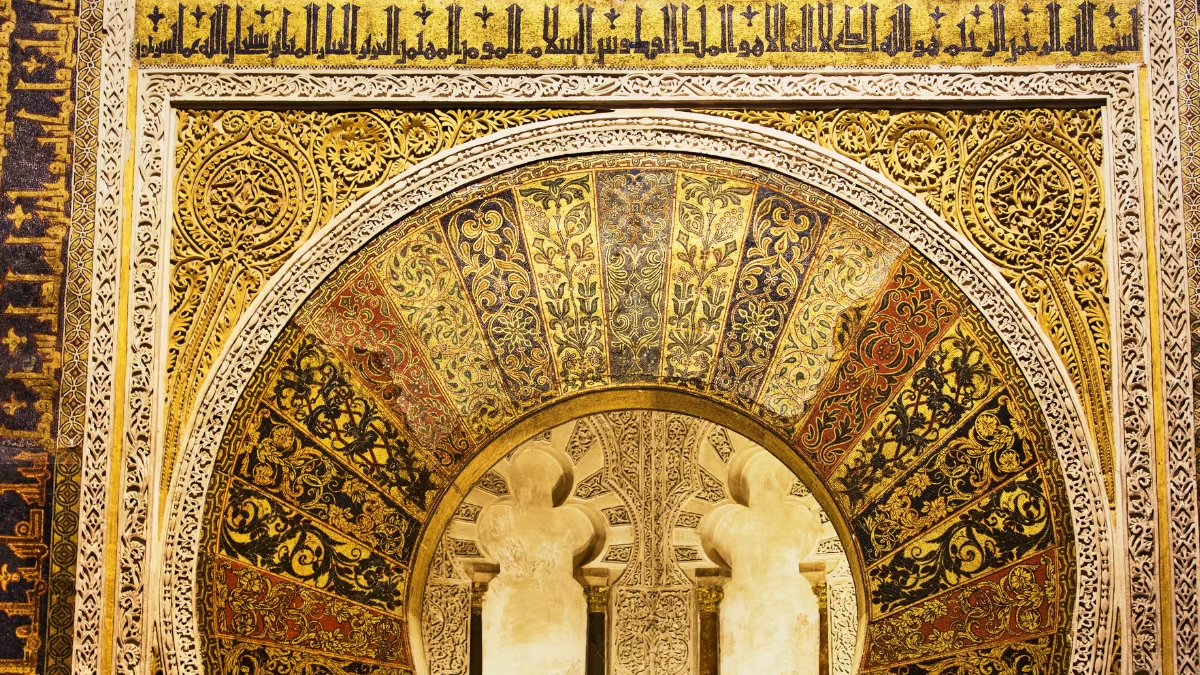
The Mezquita-Córdoba was built in 784–786 by Abd al-Rahman I on the site of a Visigothic basilica. It was expanded by three successive rulers over the following two centuries. After the Christian Reconquista of Córdoba in 1236, Ferdinand III converted it into a cathedral. A Renaissance nave was inserted in 1523. It was declared a UNESCO World Heritage Site in 1984. It remains an active Catholic cathedral today.
The Mezquita-Córdoba is not one building — it is four buildings in succession, each constructed or transformed on the same site over more than 1,300 years. Understanding that history is what separates a walk through a beautiful monument from a genuine encounter with one of the most extraordinary stories in European civilisation.
Before the Mosque — Roman and Visigothic Origins
The site on which the Mezquita stands has been sacred ground for at least 1,500 years. Archaeological evidence points to the existence of a Roman-era religious complex on this location, and from the 6th century onwards it was occupied by the Basilica of San Vicente — a Visigothic Christian church named after the Spanish martyr Vincent of Saragossa.
When the Umayyad forces conquered Córdoba in 711, the basilica was initially shared between the Christian and Muslim communities, with each using part of the building for their respective worship. This arrangement held until the Muslim population outgrew the space. By the time Abd al-Rahman I arrived and consolidated power, a dedicated mosque had become politically as well as religiously necessary.
Some remains of the Visigothic basilica are preserved within the Mezquita today and can be seen in a small exhibition area in the southern section of the building.
Phase 1 — Abd al-Rahman I (784–788)
In 784, Abd al-Rahman I — the founding emir of the independent Emirate of Córdoba and a survivor of the Abbasid massacre of his Umayyad dynasty in Damascus — purchased the basilica from the Christian community and demolished it to build a mosque. Construction began in 784 and the first phase was completed by 788.
The original mosque was a rectangle of 11 aisles running north-south, supported by two-tiered columns recycled from the demolished basilica and from Roman ruins across the former province. The innovative double arch — a horseshoe arch below supporting a semicircular arch above — was introduced to achieve greater height without requiring taller columns. This was a genuine architectural breakthrough that would define the building’s visual identity and influence Islamic architecture across North Africa and the Iberian Peninsula for centuries.
The first minaret of Al-Andalus was constructed during this period, approximately 10 metres south of the current Bell Tower’s position.
Phase 2 — Abd al-Rahman II (833–848)
Under Abd al-Rahman II, the mosque was extended southward as the city’s Muslim population grew. Eight new aisles were added, replicating the original layout and maintaining the double-arch system. The ablutions courtyard (the precursor to the current Patio de los Naranjos) was also extended.
Phase 3 — Al-Hakam II (961–976)
The third expansion, under the Caliph Al-Hakam II, is widely considered the most magnificent phase of the mosque’s construction. The prayer hall was extended further south, and the new sections show a significant leap in artistic ambition.
Al-Hakam II commissioned Byzantine craftsmen from Constantinople to create the mosaics for the new mihrab — a decision that demonstrates both the cosmopolitan connections of Córdoba at the height of its power and the caliph’s determination to create something unprecedented. The mihrab itself — an octagonal chamber with a scallop-shell dome and walls covered in gold mosaic — is the jewel of the entire building. The Maqsurah (royal enclosure) in front of it, with its interlocking arches and ribbed domes, represents one of the highest achievements of Islamic decorative art in the West.
During this period, Córdoba was the largest city in Europe, with a population estimated at 500,000 — larger than Constantinople, Baghdad, or any Christian city of the time. The library of Al-Hakam II alone is said to have contained 400,000 volumes.
Phase 4 — Almanzor (987–988)
The final expansion was carried out by Almanzor (Al-Mansur), the powerful regent who effectively governed Al-Andalus while the Caliph Hisham II was a minor. Almanzor doubled the width of the mosque by adding eight additional aisles to the east, giving the building its current dimensions of approximately 180 × 130 metres.
Almanzor’s expansion is architecturally faithful to the earlier phases but was executed with less artistic refinement. It is in the Almanzor extension that the August 2025 fire caused damage to the Chapel of Expectation — a section that had been converted and modified after the Reconquista.
The Reconquista — 1236
On 29 June 1236, Ferdinand III of Castile entered Córdoba after a long campaign. The mosque was formally consecrated as a Catholic cathedral and dedicated to the Assumption of the Virgin Mary. This marked the effective end of Al-Andalus in Córdoba.
The conversion was, by the standards of the age, remarkably conservative. Unlike many Islamic buildings in reconquered Spain, the mosque was not demolished or fundamentally altered in the immediate aftermath of the conquest. The prayer hall was repurposed for Christian worship, chapels were created along the outer walls, and the minaret was eventually incorporated into a bell tower — but the fundamental structure, the columns, the arches, and the mihrab were preserved.
The Cathedral Insertion — 1523
The most controversial decision in the building’s history came in 1523, when the cathedral chapter received permission from Holy Roman Emperor Charles V to build a full Renaissance nave and choir in the centre of the prayer hall. Construction of the Capilla Mayor and the Coro required demolishing approximately 60 columns of the hypostyle hall.
Charles V, upon visiting the completed cathedral in 1526, is reported to have said: “You have destroyed something unique to build something ordinary.” Whether he actually said this is debated by historians, but the sentiment captures the contradiction that still defines the building: an extraordinary Islamic monument with a Catholic cathedral built inside it — neither quite the same as the other, each visible through and against the other.
Modern Era and UNESCO Recognition
The Mezquita-Córdoba was declared a National Monument by Royal Order in 1882. On 2 November 1984, it was declared a UNESCO World Heritage Site — one of the first Spanish monuments to receive this designation. In 1994, the designation was extended to the entire historic centre of Córdoba. In June 2014, UNESCO further awarded the Site of Outstanding Universal Value distinction.
The building continues to function as the active cathedral of the Diocese of Córdoba, with daily masses and liturgical celebrations. This active religious use means that the Cabildo Catedral de Córdoba — the cathedral chapter — has managed and maintained the monument since 1236, a continuous institutional responsibility of almost 800 years.
The 2025 Fire
On 8 August 2025, a fire broke out in a chapel in the Almanzor extension used as a warehouse. The flames spread to the adjacent Chapel of Expectation, and after firefighters intervened, the roof of that chapel collapsed under the weight of the water used to extinguish it. UNESCO praised the cathedral chapter’s rapid response. A comprehensive restoration project was announced in September 2025, projected to complete by mid-2026. The main areas of the mosque — the prayer hall, the mihrab, and the cathedral nave — were unaffected.
Frequently Asked Questions
Who built the Mezquita-Córdoba?
The original mosque was built by Abd al-Rahman I beginning in 784. It was expanded by Abd al-Rahman II (833–848), Al-Hakam II (961–976), and Almanzor (987–988). The cathedral nave was inserted in 1523 under Holy Roman Emperor Charles V.
When was the Mezquita built?
Construction of the first mosque began in 784 and was completed in 788. The building was expanded in phases through 988. The Catholic cathedral nave was added in 1523.
Why was the cathedral built inside the mosque?
After the Christian Reconquista of Córdoba in 1236, the mosque was converted for Catholic use. In 1523, the cathedral chapter received permission to build a full Renaissance nave inside the prayer hall. The decision was controversial then and remains so today.
Is the Mezquita a mosque or a cathedral?
Both. It is officially the Catholic Cathedral of the Diocese of Córdoba, functioning as an active Catholic church. Architecturally, it is overwhelmingly an Umayyad mosque. The official name — Mezquita-Catedral — acknowledges both identities.
When was the Mezquita declared a UNESCO World Heritage Site?
On 2 November 1984. The designation was extended to the entire historic centre of Córdoba in 1994, and the Site of Outstanding Universal Value status was awarded in 2014.
What happened to the Visigothic church that preceded the mosque?
Abd al-Rahman I purchased the Basilica of San Vicente from the Christian community and demolished it in 784 to build the mosque. Archaeological remains of the basilica are preserved and displayed in a small exhibition area inside the southern section of the building.
